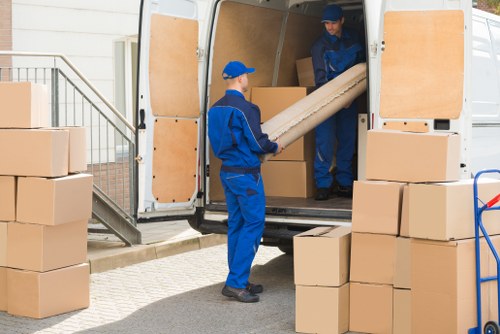
Recycling and Sustainability for Removal Companies in London
As responsible removal companies in London, we are committed to reducing waste, increasing reuse and promoting a circular approach to every clearance and move. This page explains our recycling percentage target, how we make use of local transfer stations, our partnerships with charities, and the rollout of low-carbon vans across the fleet. The approach described here is designed to align with borough-level waste separation practices while going beyond minimum standards.
 Across inner and outer London boroughs the approach to waste separation varies: many councils operate kerbside separation for mixed dry recycling, food waste and residual waste, while some boroughs emphasize segregated streams for textiles and bulky items. Our London removal teams adapt to borough policies — from Camden and Islington with strict dry recyclate rules to boroughs in South London that accept combined glass and cans at bottle banks.
Our Recycling Percentage Target
We have set a measurable, ambitious target for the business: an 85% diversion rate of reusable and recyclable material from landfill across all removals and clearances by 2030. This target covers items that are repaired, donated, repurposed, sold on, composted or otherwise processed at authorised facilities. The rate is based on weight and item counts, tracked per job and reported internally for continuous improvement.

How we track material streams
Every collection is logged with a simple waste stream breakdown: reusable furniture, textiles, small WEEE (waste electrical and electronic equipment), metals, mixed recyclables and residual waste. Our crews use mobile forms to record estimated weights and destinations, and jobs are audited randomly to ensure the recycling and reuse metrics are accurate.
We partner with a network of local transfer stations and materials recovery facilities across London to keep transport distances short and emissions low. These transfer stations include council-operated depots and permitted private transfer facilities in East, West and South London that accept segregated streams and offer processing routes for bulky items. Using local transfer points reduces double-handling and helps divert items quickly into the right processing stream.
To improve traceability, we issue transfer notes for consignments going to reprocessors and reuse centres. For larger clearances we consolidate loads to scheduled local transfer stations to maintain flow and ensure materials are matched with the correct downstream partners — for example, mattress recyclers, furniture repair workshops and WEEE processors.
Our removals in London and surrounding boroughs prioritise drop-off at facilities that provide documented reuse and recycling outcomes. This helps us maintain a high standard of chain-of-custody and demonstrate, by job, how items were treated.
Partnerships with Charities and Social Enterprises
We have formal partnerships with a range of charities and social enterprises across London that accept working furniture, clothing, books and household items. These organisations often provide collection or uplift services and take items for direct reuse, social resale or refurbishment. By directing good-quality items to charities we reduce waste and support local community services.
Our charity partners include refurbishment workshops that retrain staff and social enterprises that repair and rehome appliances. When items are unsuitable for reuse these partners often direct them into appropriate recycling streams, ensuring nothing reusable is needlessly consigned to landfill.
Fleet Decarbonisation: Low-Carbon Vans and Logistics
To tackle transport emissions, our fleet transition plan prioritises low-carbon vans — hybrid and fully electric LCVs — on urban rounds and smaller clearances. Where electric models are deployed we schedule multiple short runs within boroughs to maximize range efficiency and avoid unnecessary trips across the city. This reduces our operational carbon footprint while keeping service levels high in dense London streets.
We pair low-emission vehicles with route-optimisation software and consolidated collection days per borough to lower mileage, improve load factors and cut fuel consumption. Drivers are trained in eco-driving techniques and in-line load planning to reduce idle time and improve vehicle utilisation.
Practical recycling activities carried out by our teams across London include:
- Segregation and separate collection of textiles for charity reuse or mechanical recycling
- Careful disassembly of furniture so mattresses, timber, metal and foam are separated and sent to appropriate processors
- Collection and certified handling of small WEEE, batteries and fluorescent tubes
- Donation of usable items to borough-based furniture banks and community projects
Compliance and continuous improvement: We work within London borough waste policies and national waste regulations, reviewing processes annually to close gaps. When local councils change waste separation rules or introduce new deposit schemes, our operations adapt quickly to maintain high diversion rates and legal compliance.
 To support transparency we produce internal summaries on a per-quarter basis showing recycling percentages, reuse outcomes and emissions reductions. These reports help us refine partnerships with transfer stations, charities and recycling processors, and they drive investments in low-emission vehicles and crew training.

In summary, London removal firms and local removal teams can be major enablers of the circular economy when they set clear targets, collaborate with charities and trusted transfer stations, and invest in low-carbon transport. Our ambition as a removal company in London, and as part of the wider network of London removal companies and local movers, is to keep reusing first, recycling next and sending the smallest possible amount to landfill while supporting borough-level schemes and community partners.
We continue to evolve our processes, aiming for the 85% diversion target through measured steps: better sorting on-site, smart consolidation to local transfer points, stronger charity partnerships and a greener van fleet. This creates practical, measurable sustainability across every removal and clearance across Greater London.
Commitment: By combining targeted recycling goals, borough-aware operations, certified transfer station use, and charity partnerships with a low-carbon fleet, removal companies in London can—and should—play a central role in building a more sustainable city.